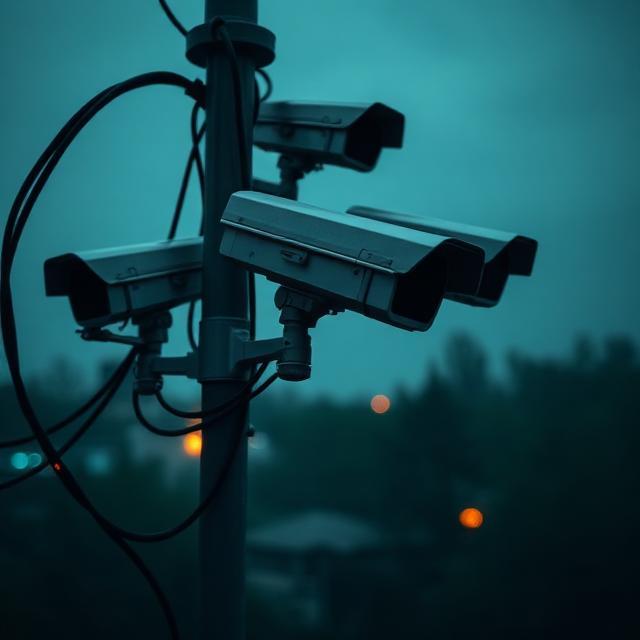
In April 2026, a short woman driving a rental car in Europe merged onto a six-lane highway and felt her accelerator die. The dashboard lit up with a message: "Sit up straight. We can't find your eyes." When she complied, the car asked permission to send her biometric data to a third party.
This is not a dystopian hypothetical. It is the lived reality of a regulatory framework set in motion decades ago and codified by the Bipartisan Infrastructure Law of 2021 — a mandate requiring every new vehicle sold in the United States to include passive driver monitoring systems capable of tracking eye movement, detecting intoxication or fatigue, and remotely disabling the vehicle. Those systems are now live, globally standardized, and increasingly connected to AI backends that flag footage for human review.
The surveillance infrastructure extends far beyond the automobile. In the same week, four concurrent developments reveal the architecture of a connected control grid:
- Lawton, Oklahoma — Police deployed Clearview AI facial recognition against residents using billions of scraped internet photos, without state-level privacy constraints.
- Santa Fe, New Mexico — A judge signaled skepticism of state demands to force Meta into universal identity verification that would link every account to government-issued ID.
- Washington, D.C. — The FCC voted unanimously to require government ID for phone service, targeting one of the last anonymous communication channels.
- Congress — Rep. Thomas Massie and Rep. Lauren Boebert introduced the Surveillance Accountability Act, demanding warrants for all government data collection, as FISA Section 702 faced renewal without reform.
This report examines the evidence for a coordinated surveillance grid, the constitutional stakes, and the legislative battle to reclaim the Fourth Amendment.
The Mandate Nobody Voted On: A Law Buried in Infrastructure
In Alex Jones' May 5, 2026 broadcast — traces the legislative lineage of mandatory in-car surveillance to the Bipartisan Infrastructure Law signed by President Joe Biden on November 15, 2021. The law included provisions requiring all new vehicles to incorporate passive driver monitoring systems by model year 2026.
"The kill switches in all the new cars, by law, this year," Jones states at the opening of the broadcast. "And again, this stuff was already in 20 years ago in fancy Audis and Mercedes... Driver assistance safety features. And for 10 years, it's in most, you know, mid-grade cars. It's in there by law now. And it's watching, it's tracking, it's controlling everything."
The legislation was framed as a safety measure — anti-drunken-driving, anti-drowsiness technology. But the technical implementation goes far beyond passive safety monitoring into active biometric surveillance.
"People are like, 'Oh, this could be dangerous,'" Jones continues. "Oh, it could make you wreck. It's already causing problems. It's way worse than that, folks. It's about getting rid of human drivers. That's the plan. And it's about getting rid of cars for the general public and private car ownership. That's all admitted by these people."
The Firsthand Account
The most compelling evidence comes not from commentary but from a caller's eyewitness testimony — a woman who rented a 2026 model car in Europe and nearly died when its AI monitoring system cut engine power during highway merge.
"I'd driven it for a day or two and I was getting on a highway. It was a six-lane highway. And all of a sudden the gas stopped working. And I'm pressing on the gas. I can't get the car to go."
The car's dashboard displayed: *"Sit up straight. We can't find your eyes."*
"The thing is, it knew I wasn't asleep because I was pressing on the gas. So it knew I was awake. It just wanted to see my eyes."
After she complied with the eye-tracking demand: "It says, 'May I send these results to a third party?' To which I said, 'No, you may not. Who is the third party? First of all, who's watching me drive the car to begin with? Secondly, who is the third party you're sending it to?'"
The caller identified a critical safety flaw in the mandate's implementation: "There are so many scenarios where losing control of the gas can put a car in a very dangerous situation. Like what if I was pulling out in front of a semi truck? What if I was going over a railroad track?"
Rep. Thomas Massie (R-KY) has since introduced legislation to repeal the mandate. Document ID 1090, an April 27, 2026 broadcast covering Massie's efforts, notes that "over the weekend, I'd see an article with 20 million reads and a video with 18 million views" — indicating the breadth of public awakening to the scope of the surveillance infrastructure.
Global Standardization
The caller's rental car was in Europe, not the United States — evidence that the surveillance framework has been standardized across borders. As Jones notes:
"Whether you're in Australia or Italy or the United States, it's all being rolled out globally by corporate standardization that's in line with the governments, just like the vaccine passports have been set up globally by the UNWF. It's all one giant plan."
Ford's latest patent, "lets your truck scan your face and read your lips. And one day it could testify against you."
The Expanding Surveillance Ecosystem: Clearview AI Comes to Oklahoma
On April 27, 2026, the Lawton Police Department in Oklahoma deployed Clearview AI's facial recognition system following an 8-0 city council vote, as documented in Document ID 1089. The system allows detectives to upload a photo and receive matches from the company's database of billions of images scraped from social media, news sites, and the open web — without the consent of the individuals photographed.
"Every face Clearview holds was added without notice or consent," the document states, "and police use of the database makes residents involuntary participants in a biometric system they were never asked to join."
The Fourth Amendment implications are stark: "The Fourth Amendment was built around the idea that surveillance" — the document cuts off, but the constitutional argument is clear. A search of a biometric database containing images of individuals who never consented to be included creates a permanent surveillance record searchable without probable cause.
ICE Smart Glasses
The DHS plans to outfit ICE agents with "extended-reality smart glasses by September 2027" — custom-built surveillance devices that will "search for key biometric information that can identify a suspected illegal alien or criminal, including facial features and their walking pattern."
Careful that you don't cheer their use against "those darned illegals." As the document notes, "This same technology could be used and abused to surveil the American public at large."
The glasses will "include cameras that can record video, analyze data in real time, and display useful information to the wearer through an eye lens." Biometric data is sent to a federal database, cross-referenced, and relayed back to the agent — a mobile, real-time surveillance network worn on the face of every federal officer.
The FCC Ends Anonymous Phones
On April 30, 2026, the Federal Communications Commission unanimously approved a proposal requiring telecom providers to verify customers' identities before activating service.
"Government-issued ID, physical address, legal name, and existing phone numbers would all be included," the document states. "The stated goal is stopping robocalls. The result would be an identity-verification regime covering one of the last semi-anonymous communication tools available to ordinary Americans."
The framework "borrows from banking's anti-money-laundering rules" and asks whether carriers should "retain identity documentation for at least four years after a customer leaves" and "check customers against law enforcement watchlists."
"Journalists use prepaid phones to protect" — sources and whistleblowers, the implication is clear. The FCC's proposal would eliminate that protection entirely.
Meta on Trial: The Surveillance Architecture in Court
A recent article reveals that New Mexico's attempt to force Meta into universal identity verification faces judicial skepticism — but the underlying demands expose the surveillance architecture being built.
"Meaningful age verification at the platform level means government IDs, facial scans, or third-party identity services that link a real legal identity to every account," the document states. "Once that link exists, it does not unlink. The pseudonymous Instagram account becomes an identity-verified Instagram account."
The state also seeks restrictions on end-to-end encryption — a move that would eliminate private communication for all Meta platform users, not just minors.
Constitutional Collision Course: The Fourth Amendment Under Siege
The surveillance infrastructure points to a systemic erosion of the Fourth Amendment's warrant requirement. The amendment, ratified in 1791, guarantees:
"The right of the people to be secure in their persons, houses, papers, and effects, against unreasonable searches and seizures, shall not be violated, and no Warrants shall issue, but upon probable cause, supported by Oath or affirmation, and particularly describing the place to be searched, and the persons or things to be seized."
Yet the government now conducts warrantless searches across multiple domains:
1. In-vehicle biometric surveillance — cameras track eye movement, record video, and flag content for human review without judicial oversight
2. Clearview AI facial recognition — billions of facial images searched without probable cause
3. FISA Section 702 backdoor searches — the FBI searches Americans' communications without warrants
4. Data broker purchases — agencies buy location data, browsing history, and financial records without court authorization
FISA Section 702: The Legal Loophole
A column by Reps. Keith Self and Andrew Clyde published April 23, 2026, exposes the core of the warrantless surveillance apparatus:
"Section 702 of the Foreign Intelligence Surveillance Act expires on April 30. Intelligence agencies want an 18-month clean extension — no changes, no reforms, no warrant requirement."
The problem, as the column explains, is not foreign surveillance but its domestic spillover: "When those foreign targets communicate with Americans, those American messages get swept into the database too — hundreds of millions of them. And then the FBI can search through those communications."
As this column notes, "These 'queries' for Americans' information is what we call 'backdoor searches,' and it is central to the raging fight over whether to reauthorize FISA. A federal court called it unconstitutional. The searches keep happening anyway."
The document also raises the AI dimension: "The government can now train AI on information about your constitutionally protected activity, from what you buy to what websites you visit to where you sleep at night, all based on information purchased from data brokers without any court or law authorizing agencies to do so."
The [FAILED] Surveillance Accountability Act
In response, Rep. Thomas Massie (R-KY) and Rep. Lauren Boebert (R-CO) introduced the Surveillance Accountability Act, detailed in Document ID 1054. The bill "aims 'to ensure that all searches that significantly impinge on the privacy or security of a person require a warrant based on probable cause' and to create 'a right of action for violations of Fourth Amendment rights.'"
The bill covers "the kinds of searches federal agencies currently conduct without judicial oversight: pulling your financial records from banks, requesting your browsing history from ISPs, buying your location data from brokers, and harvesting your biometric information from surveillance cameras."
As Rep. Massie explained in Document ID 1045: "There's been so many erosions of our Fourth Amendment right to privacy... the Bank Secrecy Act, the Right to Financial Privacy Act, the Patriot Act. All of these have great sounding names, but all of them created so-called loopholes in the Constitution."
He added a chilling detail from his congressional work: "I've been in a skiff last week where I saw two secret rulings, interpretations of FISA law of how the government has created additional loopholes to spy on you that I'm not even allowed to tell you."
AI Without Wisdom
A recent article highlights a warning from comedian Zach Galifianakis that resonates beyond entertainment: "These dudes [AI]... they have math minds. But there's very little wisdom coming out of that pocket of the world. Almost none. And we're just running. All of us are running in that direction."
As Galifianakis noted: "I think this whole AI thing... it's another like biblical... biting the apple again. I just am very afraid of it... especially the dudes that are designing it."
Historical Context — A Plan Decades in the Making
From Cable Boxes to Neural Interfaces
The surveillance infrastructure did not emerge suddenly. Tracing the timeline:
"That was the first ever report in 1996. The Scientific Atlantic cable boxes had a hidden microphone in them long before they started saying, 'Oh, that's for voice activation.'"
By 2012, CIA Director David Petraeus acknowledged the extent of the surveillance apparatus. As one article recounts: "CIA director says your washing machine is watching and listening to you already, and he said it was a good thing."
Jones contextualizes the driver surveillance mandate within a larger framework: "Since the 50s, developed this plan to bring in a total panoptagonic surveillance system to control you. That's what the internet was designed to do. It was called the Intergalactic Communication System. So from moment one, it has been about control and about making humans obsolete."
The AI Control Grid Vision
Alex Jones describes the endgame: "It's a neural mass interface. With billions of humans and computer nodes. Literally hooking into humanity, tracking humanity, controlling humanity, creating a new entity."
This aligns with the MIT report cited in the broadcast: "The scenario they tell you, like the third scenario is we merge with AI. That's our only hope. Well, they've been saying for 30 years... this has been their big project, their big plan."
Resistance and Countermeasures: Legislative Action
The Surveillance Accountability Act represents the most comprehensive legislative response to date. Its core provisions:
- Requires warrants based on probable cause for all government data collection
- Creates a private right of action for Fourth Amendment violations
- Covers financial records, browsing history, location data, and biometric information
- Closes the loopholes opened by the Patriot Act, Bank Secrecy Act, and other laws
Technical Countermeasures
Document ID 1065 — a February 13, 2026 interview featuring Tucker Carlson — outlines the technical foundations of resistance: "With a very little amount of energy, a minuscule amount of energy, a laptop, a battery and a few milliseconds of computation, you can create a secret that not even the strongest imaginable superpower on earth is able to without your explicit granting of access, are able to recover."
That fundamental principle — end-to-end encryption — remains the primary technical barrier against mass surveillance. The fight against encryption mandates (as seen in the New Mexico Meta case) is therefore a fight over the viability of private communication itself.
What Citizens Can Do
Based on the evidence compiled from these documents, concerned citizens should:
1. Contact Congress — Support the Surveillance Accountability Act and demand the FISA 702 warrant requirement
2. Disable in-vehicle monitoring — Where possible, check vehicle settings for driver monitoring features and disable data sharing
3. Use encrypted communications — Signal, ProtonMail, and other end-to-end encrypted services remain the primary technical defense
4. Opt out of data brokers — Services like DeleteMe can remove personal data from broker databases that law enforcement accesses without warrants
5. Support privacy legislation — The Massie-Boebert bill and related reform efforts need public pressure to overcome intelligence community opposition
Conclusion
The evidence compiled across Paperless-ngx documents reveals a sobering picture: the infrastructure for comprehensive, biometric, AI-driven surveillance is not coming — it is here. From the car that tracks your eyes to the police department that scans your face to the FCC that wants your ID to place a phone call, the control grid is operational and expanding.
As a caller concluded after her near-fatal highway experience: "It's not something that's happening in the future. It's something that's happening now."
The question is whether Congress, the courts, and the American people will act before the surveillance architecture is complete.
---
Sources
| Source | Document ID | Title | Date |
| Alex Jones | 1199 | AI CONTROL GRID IS HERE | May 5-6, 2026 |
| Alex Jones | 1090 | Massie trying to repeal Biden law for cars | Apr 27, 2026 |
| Reps. Keith Self & Andrew Clyde | 1043 | FBI should get a warrant before reading your messages | Apr 23, 2026 |
| Ken Macon, ReclaimTheNet | 1089 | Lawton Police Deploy Clearview AI Facial Recognition | Apr 27, 2026 |
| Zach Laidlaw, TheBlaze | 1208 | ICE's new smart glasses promise surveillance superpowers | May 7, 2026 |
| Dan Frieth, ReclaimTheNet | 1209 | Judge Doubts State's Meta Surveillance Plan | May 6, 2026 |
| Ken Macon, ReclaimTheNet | 1211 | FCC Wants Your ID Before You Get a Phone Number | May 6, 2026 |
| Dan Frieth, ReclaimTheNet | 1054 | Surveillance Accountability Act Demands Warrants | Apr 23, 2026 |
| Reps. Boebert & Burlison, Breitbart | 1044 | Government is Spying on Gun Owners | Apr 23, 2026 |
| ReclaimTheNet | 1045 | Massie and Boebert: government spying, get a warrant | Apr 23, 2026 |
| Tucker Carlson | 1065 | Technology stole your privacy and your freedom | Feb 13, 2026 |
---
Published May 21, 2026. Investigative Research Unit.